
In warehouse automation, conversations often focus on speed, payload capacity, lift height, navigation accuracy, and artificial intelligence. These specifications are important, but they only tell part of the story.
The real test of an autonomous forklift or AGV begins when something doesn't go according to plan.
A pallet is slightly misaligned. A storage cage is out of position. A temporary obstacle blocks the planned route. A barcode cannot be read on the first attempt.
In real manufacturing and warehouse environments, these situations happen every day.
The question isn't whether an autonomous mobile robot (AMR) or automated guided vehicle (AGV) will encounter errors. The question is:
How well can it be recovered?
Recovery capability is one of the most overlooked factors when evaluating warehouse automation solutions, yet it often has the greatest impact on uptime, productivity, and long-term return on investment.
Simulation environments are controlled.
Production facilities are not.
Every day, warehouses deal with:
A robot that performs flawlessly only under ideal conditions will spend a significant amount of time waiting for human intervention.
That is where productivity begins to disappear.
Many vendors advertise impressive cycle times under perfect operating conditions.
However, a warehouse operates thousands of transport missions every day.
If even a small percentage requires manual assistance, those interruptions quickly accumulate.
Consider a facility operating:
That results in:
The vehicle itself may still be technically "fast," but the overall system productivity is significantly reduced.
The true measure of automation is not maximum speed.
It is how rarely operators need to step in.
Modern autonomous forklifts are becoming increasingly capable of handling unexpected situations without requiring human assistance.
Instead of immediately stopping after detecting an issue, advanced systems can:
This process often takes only seconds.
Without intelligent recovery, the same scenario could require an operator to travel across the warehouse simply to acknowledge an alarm and restart the task.
This important distinction is often overlooked. An error does not necessarily mean the mission has failed.
For example:
The "error" existed, but the operation still succeeded.
That difference dramatically changes the economics of automation.
One increasingly valuable capability is the intelligent retry function.
Instead of giving up after one unsuccessful attempt, the robot can perform a structured recovery sequence.
Depending on the application, the system may:
This layered decision-making allows many common warehouse exceptions to be resolved automatically.
The result is fewer alarms, fewer operator callouts, and higher equipment utilization.
Effective recovery depends on more than software. It requires reliable environmental understanding.
Leading autonomous forklifts combine information from multiple sensing technologies, including:
Rather than relying on a single sensor, the vehicle compares multiple data sources before deciding how to recover from an unexpected condition (Sensor Fusion).
This significantly improves reliability in dynamic manufacturing environments.
When an autonomous robot encounters an unexpected obstacle, the goal isn't simply to find another path. The recovery process must be predictable, consistent, and aligned with the facility's safety strategy.
Rather than making arbitrary decisions, modern AGVs recover using predefined operating rules that prioritize both productivity and personnel safety.
This approach allows vehicles to respond intelligently while maintaining behavior that operators can anticipate and trust.
Advanced autonomous mobile robots use strategic obstacle avoidance based on a digital understanding of the facility.
Instead of selecting random alternate routes, vehicles evaluate their environment using mapped travel lanes, traffic flow, blind spots, intersections, and restricted areas before determining the safest recovery path.
By following predetermined avoidance strategies, the robot minimizes unnecessary movement while keeping operations orderly and predictable.
This structured decision-making is especially valuable in busy manufacturing environments where multiple autonomous vehicles, forklifts, and pedestrians share the same workspace.
One of the greatest safety benefits of autonomous material handling is consistency.
Human drivers naturally vary their decisions based on experience, fatigue, or changing conditions. Autonomous vehicles, on the other hand, execute recovery procedures according to predefined rules every time.
This consistency allows nearby workers and manually operated vehicles to better anticipate AGV behavior, reducing unexpected interactions and improving overall warehouse safety.
Predictable behavior isn't just good for automation. It makes the entire facility easier to operate.
Effective recovery never ignores the facility's safety infrastructure.
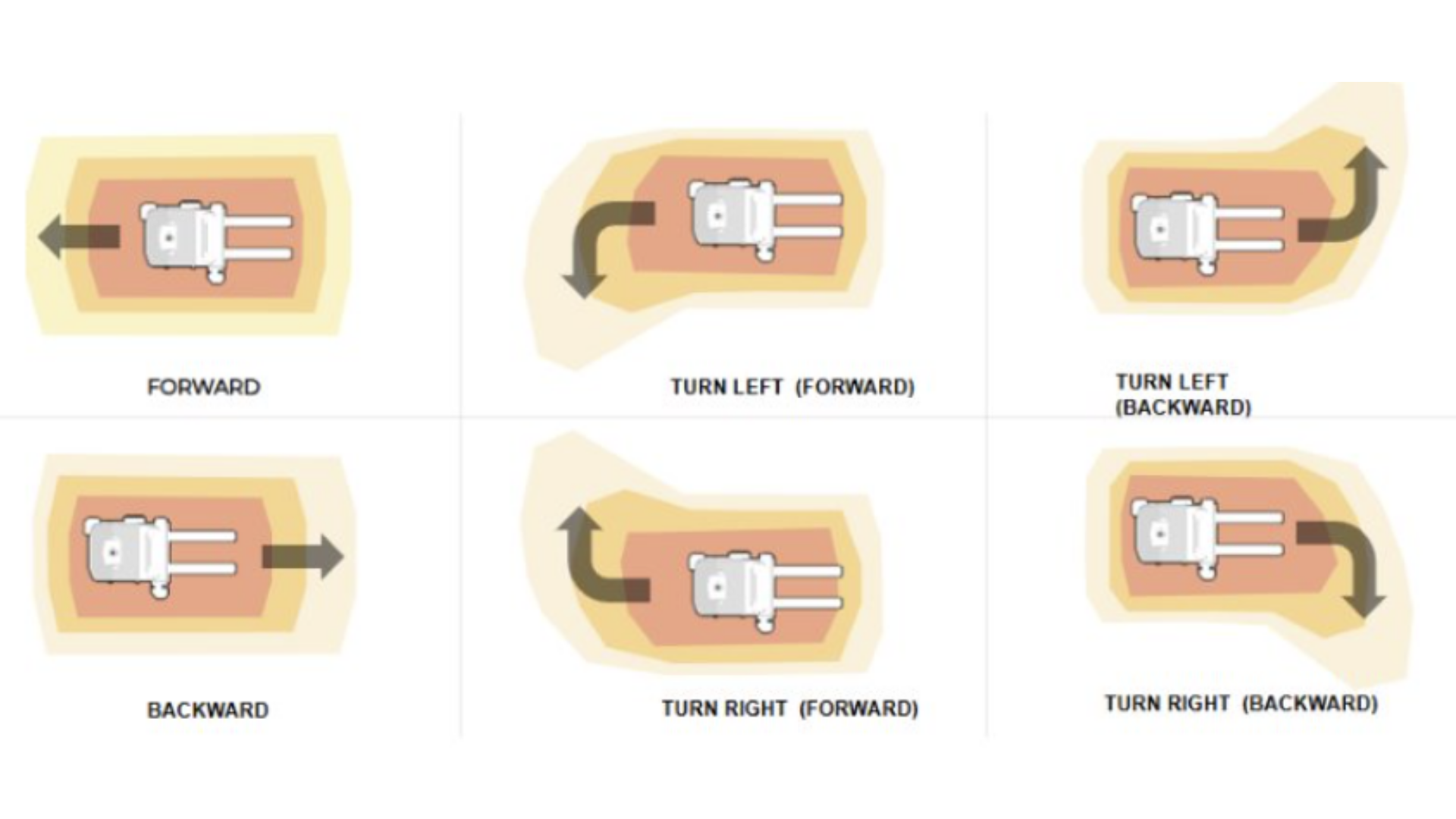
When an obstacle is detected, the vehicle considers established operating zones, including:
Rather than simply navigating around an obstacle, the robot selects a recovery path that remains within these predefined safety boundaries whenever possible.
This ensures that recovery enhances operational continuity without introducing new risks.
The best autonomous systems recover using the same operational rules that govern every normal mission.
Speed limits remain enforced.
Yield priorities remain unchanged.
Stopping distances are maintained.
Traffic management rules continue to apply.
Because recovery follows the same established logic as routine operation, facilities gain automation that behaves consistently under both normal and unexpected conditions.
That consistency is one of the defining characteristics of a mature autonomous system.
One of the primary goals of warehouse automation is reducing repetitive manual work.
If operators spend their day responding to recoverable robot alarms, much of that benefit is lost.
The most effective autonomous systems quietly resolve routine exceptions without interrupting production.
Operators only become involved when genuine human judgment is required.
That is where automation delivers its greatest value.
Recovery capability is rarely highlighted during product demonstrations, but it should be.
When evaluating autonomous forklift solutions, consider asking:
These questions often reveal far more about long-term usability than a simple cycle-time comparison.
Every autonomous vehicle will eventually encounter unexpected situations.
That is simply the reality of warehouse operations. The difference between a good automation system and a great one is not whether errors occur. It is how intelligently the system responds.
The best autonomous forklifts minimize downtime by recognizing common exceptions, adapting to changing conditions, and recovering automatically whenever possible. As warehouse automation continues to evolve, recovery capability will become one of the defining characteristics of truly autonomous operations.
Specifications can tell you how much a robot can lift, how high it can stack, or how fast it can travel.
They cannot tell you how well it performs on an ordinary Tuesday afternoon when pallets are slightly out of place, aisles are busy, and production cannot afford delays. That is where recovery matters most.
When evaluating an AGV or AMR solution, don't just ask how the robot performs when everything goes right.
Ask what happens when something goes wrong. The answer may be the most important indicator of long-term success.